Showing posts with label #COVID19. Show all posts

Tuesday, 10 May 2022

May 10

 Oh, dear!

In my last school report just months before World War Two broke out the report from my history master was devastating. ‘Too vague and romantic’, he  wrote, accurately. He meant my knowledge of and enthusiasm for dates and monarchies was abysmal. 

It has never improved as my blog yesterday confirmed. 

Any of my readers - are there any? -  could see the catalogue of errors. Robert, who must live and breathe figures pointed them all out and he will edit my offering.

So thank you, Robert and for the rest of you, please forgive me. I will not  be quoting dates again. 

 With my failing memory, it is fatal.


 enthusiasm for dates and monarchies  most of it eas made up


Skinner


Monday, 9 May 2022

Historic


June 2022. An historical month and year. The platinum anniversary of the queen’s reign that began dramatically with the sudden death death of her father, King George V1 in 1952.

I remember it well, and many royal events, going back to the solemn radio announcement of the death of King George V and  in the 86 years since, those that have shaped her.

I recall as a schoolboy standing in the crowds opposite Wandsworth county hall for what I think must have been a visit by the queen’s mother Queen Elizabeth soon after the abdication of uncrowned Edward VIII.

We waved the mini flags and ‘goody bags’, gifts, I presume, from Wandsworth council.

I have seen the queen many times, first when I was a reporter covering her visits to Wales. Always at the rear of the press motorcade, when she stopped for an engagement I had to race up and report it.

When we were in our flat in Caerphilly Rosemary set  up a camera in our window overlooking the main Street to get an exclusive picture for the South Wales Argus as the queen drove past.

She missed it. 

Later, when I was city and county public relations officer I was at royal lunches in the city hall .

I have even provided briefing notes for her visits.

And, a unique experience, I went down a coal mine with her in the Rhymney Valley, following her as she stopped to talk to colliers and pat pit ponies.

My last royal  experience was an evening at Buckingham palace seven years ago, celebrating the fiftieth anniversary of the Winston Churchill Memorial Trust of which I am now the oldest member in Wales, and was introduced to her and the Duke of Edinburgh.

But that’s enough name dropping!

As almost the same age as Her Majesty, I had hoped I might get an invitation to the celebrations in London. I am still waiting.


I went down a coal mine in the Rhymney Valley with her.

Two of the most exciting royal events were the gardena


Saturday, 31 October 2020

Coronavirus diary, Saturday 31 October


Home again

After three weeks in hospital, coming home to Sunrise was a huge relief. Unexpected. 

In hospital I was concerned that I would not be able to able to look after myself and would have to go to a nursing home.I asked Robert to see if it might be the Waverley in Penarth,

Life in hospital was so different. My world had shrunk to a bed, a table and a cupboard for my possessions. Time had no meaning. Day and night merged into endless intermittent checks. blood pressure, temperature, drips and needles

The first two weeks was a blur but life suddenly opened up with new tablets. For the first time for weeks I could move my legs without pain; a few days later I was able to get out of bed and with the help of a physio, take a few steps, dragging my right leg, encased in a heavy box on my broken ankle.

After a few false alarms I was ready to leave for home.

The elation of  the return was tempered by doubt over whether I could still be able to look after myself.

As usual I made a list of ‘tasks’, the first of which was how to get about the flat. I have two more weeks with the boot, so progress is slow.

Life has changed totally, again. Being looked after so well, being able to talk to the carers despite having to stay in my flat for another week or two. And the bliss of a good night’s  sleep with little pain. 

Time is still unimportant and I am learning to be patient. To go slow, pace myself and work out a routine. 

Then there is  the pleasure of reading, writing and listening to music. 

Best of all, there is peace and comfort

It’’s great to be home and to look forward to the days and weeks ahead. 

I have been encouraged and buoyed by the support of all the family and by the welcome home from the marvellous Sunrise team.

Wednesday, 24 June 2020

Coronavirus diary, Wednesday 24 June


Boris Johnson announces an easing of England's lockdown
The Prime Minister's decision to relax many of the English lockdown restrictions and to opt for one metre safe distancing has opened up a yawning gap between England's approach and those of Wales, Scotland and Northern Ireland. 

July 4 is being hailed as freedom day for England, implying that the other countries are still being held captive.

Life will be on a different level in England, with pubs, hotels, restaurants and hairdressers back in business and people being able to holiday in England - but not yet in Wales! - in B&Bs, cottages, camping and caravan sites. 

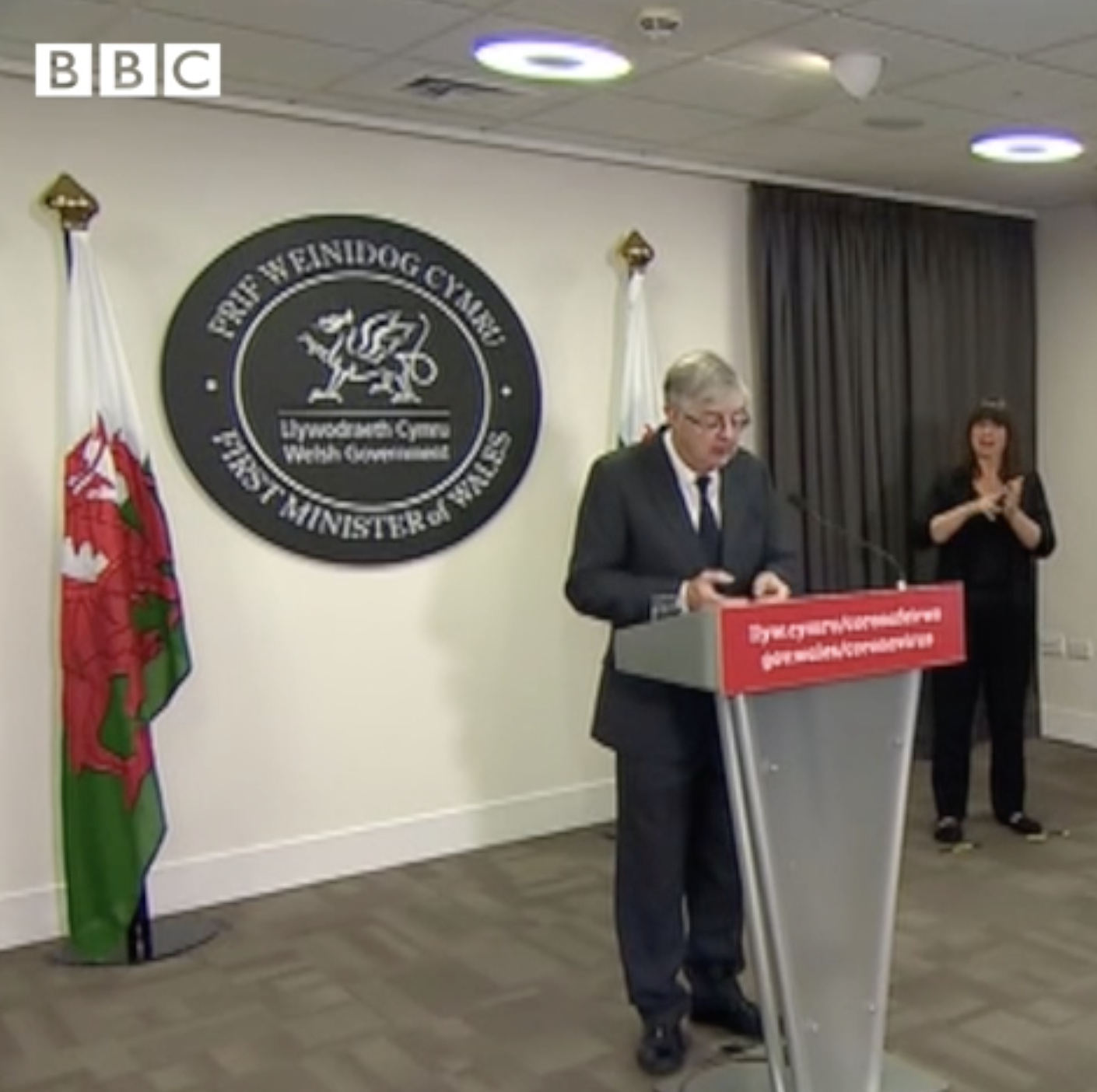
Cautious: Wales First Minister Mark Drakeford
Surprisingly, in Wales at least, most of us seem to accept the decision of ever cautious First Minister Mark Drakeford to hold back our 'get out of jail' date. Not all, though. 

The tourism and hospitality industries are shocked and dismayed, protesting at losing precious weeks of their already truncated summer season.

They have a point; it seems they will not be back in business until mid or late July. They are frustrated by the uncertainty and are urging the Welsh government to be definite and to give a date so they can prepare.

It is not all plain sailing for Mr Johnson, either. 

No sooner had he made the freedom announcement he muddied the water on the safe distance controversy by not making it a hard and fast rule but advising that people they should stay two metres apart and if that was not possible, one metre plus.

He might also be worried by the shot across the bows from the big guns.

The presidents of the Royal College of Surgeons, Physicians, Nursing and GPs 'are calling for a 'significant review' - why would it not be significant? - to 'properly prepare' - why the 'properly? - for the real risk of a second wave of coronavirus. 

They have, more more usefully, suggested the setting up of a cross-party group to plan ahead, something that should have been done months ago.

The government's two chief health advisers in England have added to the warning signals.

Mr Johnson, you have been warned!

Why is there such a difference of opinion about exiting lockdown?

One reason is that Conservative controlled England has an eye on the economic situation while the left have more regard for health and safety.

What is certain is that the future is uncertain, just as the whole pandemic story has been from the start.

No one knows, neither governments nor people. 

Saturday, 6 June 2020

Coronavirus diary, Saturday 6 June


It is not only the Chancellor of the Exchequer who is spending lavishly - £100 billion this year. The NHS and Health Secretary for England Matt Hancock are just as generous.

Both have perfectly good reasons - the Chancellor, to save jobs and businesses, Mr Hancock, lives. 

Are we getting value for this outpouring of our money?
People seem satisfied with the economic plan but questions are being asked, not of the scale of health spending, but if we are getting value for money. 

Reports suggest that it may not be so. With temporary tendering rules relaxed because of the need for quick action, scores of contracts were handed  to private firms, some of which had never before worked for the government.

Some examples of where the money is going: 
£341 million for PPE - personal protective equipment - needed at very short notice - £421million for the testing project, £34 million for management consultants, £10 million for 'financial advice'. 

According to the Times newspaper, altogether, £1.7 billion has gone in private contracts with one, worth £168 million, awarded to a small family owned pest control company with sixteen employees. £200,000 went to a call centre company to clear a backlog of calls. 

The government said working with the private sector had been a vital part of the response to the coronavirus crisis and that being able to provide supplies, equipment and services at speed had been critical.

Friday, 29 May 2020

Coronavirus diary, Friday 29 May


A lovely summer day, with the weather set fair for the week-end. Perfect for a drive to the beach or the country, a trek up Snowdon perhaps. Not possible, though, in Wales. Unlike England, the Welsh government is being ultra cautious in easing the restrictions we have had to put up with for ten weeks. 

Cautious: Mark Drakeford
One of the concessions made by First Minister Mark Drakeford today is to allow meetings between family and friends but only up to six people. A welcome chance to see parents or grandparents, perhaps, but it must be in the open air and two metres apart. 

But not yet...
Lucky England will make the most of the sunshine by crowding the roads and beaches. Although Wales is out of bounds, the Welcome to Wales signs won't be covered - but the Welsh police forces will turn back any holiday invaders. 
And this is the only the second summer since tolls at the Severn bridges were abolished. 

Inevitably, the official government advice is, well, officious. If you ask, can I go for a walk? the answer, 'Going for a walk and also shopping, to have something to eat and, for example, to sit in he park, is intended to be permitted'. When  will they make up their mind if it is permitted? 

Summer 2020 will be remembered as the dullest ever, even if the sun shines non stop. No Ceredigion National Eisteddfod, and the Llangollen International Musical Eisteddfod postponed to next year, like many other major shows and sporting events. In England, Premier League football is due to restart in mid June, behind closed doors with piped applause.

But it is all in a good cause - to save lives. Wales has been more stoical than England in accepting the harsh restrictions, and more patient. We are heartened and relieved that coronavirus death numbers are falling,  

Tuesday, 26 May 2020

Coronavirus diary, Tuesday 26 May


After avoiding our hospitals being overwhelmed and seeing the rate of infections and deaths coming down, the emphasis now is on finding a solution to the coronavirus danger. And like every other aspect of the story so far it is shrouded in uncertainty.


Ambitious plans, based on calculations, perhaps even guesswork as no-one  pretends to know the answer. It all sounds very scientific; a three-point plan with neat media friendly soundbite headings: 
Test, Track and Trace. But before this came the idea of the herd system, letting the virus run free but that was quickly dropped and the three point plan devised.

Test: Testing has been a controversial subject from the early days with the first target of 100,000 a day not met, leading to disappointment and accusations of incompetence. 

The aim is to find out who has had the virus and where it is spreading. Success depends on the volume and accuracy of the figures. The pilot scheme involving the 6,000 Isle of Wight  residents appears to have fallen far short yet it is still due to be 'rolled out' across the country.

Track:The aim is to find 30,000 households in the UK to be regularly tested for evidence of immunity after infection. This should provide evidence of how the virus is moving through the population. It would also influence decisions on social distancing  vital to get the economy moving.

Trace: People who may be infected alert others who might be exposed, passing on the message by mobile phone. 

All this sounds perfectly reasonable, and the system devised and operated on a far larger scale in other countries has proved successful.

Doubts about the British effort  have  already been expressed  People have been remarkably obedient, compliant even, obeying the government's strict orders so far, but and there is no doubt that armies of volunteers needed to make the  system work must provide enough accurate information.

The plan's success would be followed by the discovery and production of a new vaccine on  which several countries are also engaged. In the UK, thousands of volunteers are testing a possible vaccine being developed at Oxford and we have been assured that if trial are successful we could have millions of  doses available by September.

Amazingly, according to a report today, all this might be a waste of time and effort.

VIRUS MAY VANISH TOO FAST FOR VACCINE TRIAL, says the headline. That's the view of  Professor Adrian Hill, co-leader of the Oxford University project. He says a trial of 10,000 people could return no result because not enough volunteers would be infected. If  so, the result would be useless, he insists.

So where do we go from here? It looks as though it is back to guesswork. 

Tuesday, 19 May 2020

Coronavirus diary, Tuesday 19 May


The pandemic is putting a strain on the unity of the United Kingdom. Instead of pulling together the four countries are going their own way, adding to the general confusion exposed almost daily by conflicting reports from government ministers.

Scotland, Wales and Northern Ireland are taking the opportunity to rebel against what they see as a dominant England with the Prime Minister dismissive of them and their legitimate aspirations and responsibilities for their people.
He does not seem to appreciate the danger and increasing possibility of a disunited UK.

The latest example of the revolt is the decision of all three devolved countries making their own decisions on relaxing the lockdown, to follow their own chosen path in what is probably the most crucial to be made in defeating the coronavirus. All have ignored England's early easing up orders, maintaining strict lockdown but introducing their own variations - from today Northern Ireland is allowing larger groups of people to gather.

They are accused of political opportunism when unity has never been more important for the nation's future.


Nicola Sturgeon
Scotland is considered the main culprit, the Prime Minister accusing Nicola Sturgeon, Scotland's First Minister, of craftily taking advantage of the crisis to advance its case for independence.  She hits back by asserting she is only following the wishes and interests of the majority in Scotland. She is seizing the opportunity by criticising Johnson's every move while conveniently forgetting her own deficiencies.


Bombings in Wales, 1969
Independence is a forlorn hope, impractical, for Wales and Northern Ireland. Wales's half hearted campaign peaked    50 years ago with a small band of hot heads. The 'highlight' was a number of bombings around Wales at the time of Prince Charles' investiture as Prince of Wales in Caernarfon in 1969. 

Both countries have the responsibility to safeguard and improve life for their people which, they maintain. could be achieved in the aftermath of the pandemic by having greater control, responsibilities and finance. The government could avert the danger of the union splitting up by conceding. They could make the devolved countries more efficient by altering the funding, giving them more power to manage their own tax system and, most important, give their local authorities greater power and responsibility, especially in overhauling social care

Local government has been brought to its knees by years of neglect and two complicated reorganisations. Now is the time for unity, not division.

Monday, 18 May 2020

Coronavirus diary, Monday 18 May


It looks as though we might be waking up from the deep sleep of lockdown, looking out on a window to a brighter world. 
There is more good news than for two months, encouraging optimism.

Italy: slowly getting back to 'normal'. Photo: AP
After weeks of doleful daily tolls, fewer deaths are being reported with some countries cautiously celebrating their first day with none. Italy, one of the worst hit countries with over 31,000 deaths, has a lot to be cheerful about. It is coming to life again. Factories and parks have reopened, followed today by bars, shops, restaurants, cafes and hairdressers. People travelling to Italy won't have to self isolate fo two weeks.The prime minister admits it is all a calculated risk but necessary to save the economy.

The borders are opening up in the Baltic countries and in the other parts of Europe. France has described its own road map as a progressive and controlled exit plan.

That is more than can be said of the UK's efforts to decide on safe moves forward that will balance the health and economic issues. With factories and businesses open again, people were pouring back to work today; rail services back to seventy percent normal but workers are encourage to go by car or bike.

The school reopening argument is still raging, the government holding firm, but there is the same uncertainty over many other questions which the Prime Minister will not answer. He is still dithering over the foreign travel restrictions that will delay the revival of tourism although the airlines say they will increase services in two weeks time..

There are more promises as usual from the government, the latest is that we are near the target to collect contact tracers and that we might all be getting the anti virus jab in a matter of months, eagerly splashed by the newspapers. Still, it is better than bad news.


Sunday, 17 May 2020

Coronavirus diary, Sunday 17 May


So, what will happen when the coronavirus dragon is slain? What sort of life will we lead when, gradually, memories of lockdown, loneliness and fear subside? How will we look back on these mad months of surviving the hidden menace? I think, perhaps surprisingly, we will adapt as we have had to do throughout our lives. There will be no VE Day like celebrations, but an overwhelming sense of freedom and relief, the chance to get on with our lives as we wish, although millions who will have lost their jobs will face difficult years.

Yesterday's world of work. Photo: Michael Brennan/Getty Images
Some changes are inevitable; working from home will help to reduce the commuter rush, with many deserted high rise office blocks in our city centres converted to homes or other uses. Our high streets will come alive again. Business executives will save time, money and our natural eco system by reality conferencing, not flying round the world.

But I believe we will very soon relish the return of simple, everyday pleasures that were suddenly taken from us and which we have missed so much. To be able to walk out of our house any time we like, saying hello to a policeman knowing he is now saving us from criminals not lecturing or fining us. Just think of the pure joy of family get togethers, going out with friends, partying, shopping, seeing our children off to school.

Wales v France, February 2020. Wales are still Six Nations champions!
We won't, I am sure, abandon television that has done a brilliant job entertaining and educating us but can't wait to see blockbuster films in the cinemas. We will be happy to queue for concerts and shows.The reopening of churches and hearing their bells ringing will bring comfort and joy to millions. We can't wait for sport of all kinds to be back, to take part in or watch. Holidays? We may not be able to fly off so easily and cheaply around the world to new exotic destinations but there is so  much treasure here in Britain still to discover. 

If 2020 is the year of fear, uncertainty and separation, let's look forward with hope and confidence to 2021. I can't wait.


Saturday, 16 May 2020

Coronavirus diary, Saturday 16 May


Politicians, like journalists, are not the most trusted professionals, but I am starting to feel sorry for our government and the motley crew of ministers. Whatever they do is criticised and they get scant praise when they get things right. In these critical days with so much uncertainly it is getting worse for them. 

The latest example is their plan for more children in England to go back to school next month. No one can be certain if it is the right decision, if it is safe for children, teachers and other school workers. The decision, like all the others being taken day by day by the government to defeat the virus, is based on expert advice with which they are almost inundated. 

Following on immediately from the care homes furore we have another bitter, dangerous  battle, all the more divisive as it is coloured by politics which should have no part in it.
The teachers unions are almost all united in their opposition with the doctors' major organisation supporting their view that there is still doubt which should be clarified. The government can point to the experience of schools that have carried on, reducing class sizes and trying to meet the safe distance rules. Even parents who are teachers are divided. 

As usual, the papers make it a black or white - red or blue - issue, with a typical headline, Schools to defy unions and open next month. Another complication: many private schools have from the start introduced sophisticated reality teaching with teachers in touch with their individual pupils, continuing the set curriculum. My grandson is even taking his school examinations this week. Disadvantaged children, on the other hand, are losing months of education which they will probably never make up.

Back  to  politics. Sir Keir Starmer, the Labour leader is treading a treacherous path. He has the right and the duty to criticise the government even in this almost wartime scene but should do so without crossing that indefinable political line. I don't envy him, or the government.


Friday, 15 May 2020

Coronavirus diary, Friday 15 May


If there is one certainty among the utter confusion created by the coronavirus pandemic it is the disastrous effect it's having on the global economy. Every country is affected. None know how bad the next few years will be. All they can do in these first frenetic months is to try to save jobs and keep the economy afloat. 

Chancellor: bold action. photo via Getty Images
It is a formidable task for Britain. We are in the worst recession ever, say all the experts, much worse than the 2008 financial crash from which it has taken over 11 years to recover. With millions of jobs already lost and the economy almost at a standstill the Chancellor has taken bold, desperate almost, efforts to keep us afloat. The cost of supporting workers, businesses and the NHS for a year will be £300 billion, according to the Office for National Statistics.

Grounded: 12,000 jobs at BA. Photo: PA
The save jobs scheme for furloughed workers, first estimated to cost £28 billion, has now been extended adding many more billions. Chancellor Rishi Sunak has been praised for his swift, bold action and his openness - rare among his cabinet colleagues. Without that instant aid thousands of businesses would have collapsed but many are on the brink, Among the worst affected are the aviation and hospitality  industries. British Airways is sacking 12,000 workers and  other airlines are shedding jobs and mothballing planes. The optimists say Britain's economy could bounce back in a year or so; the pessimists see years of austerity and hardship ahead, worse than the past decade. 

Adding to the uncertainty is Brexit, sidelined now but with crucial deadlines ahead. If no deal is reached by 31st December Britain will have to try to make new trade deals with countries that will be, like us, struggling to get their economies back on track. Britain has been bankrupt before, of course, after two world wars, with similar mountains of debt but we have survived.

It exists after all...
Mrs May as Prime Minister, told Labour in the 2017 general election that there was no magic money tree. Chancellor Sunak seems to have found a magic forest. 


Thursday, 14 May 2020

Coronavirus diary, Thursday 14 May


Headlining the care home crisis
When the inevitable public inquiry into the coronavirus pandemic is held - and it must not take years as so many have in the past - one subject that will most worry the government is care homes.

After weeks of non stop criticism from care home residents, distraught families and the media, anger is at its fiercest. And it appears to be justified. The elderly and most vulnerable have been cruelly neglected, leading to what has even been described as a massacre.

The figures speak for themselves. Nearly 10,000 care home residents have died, according to the Office for National Statistics,  although the figure is thought to be much higher. In one week this month care home deaths accounted for forty percent of all deaths. In Wales, 1,000 have died.

The government is being blamed for a catalogue of errors: ignoring the obvious danger, not providing protective equipment for homes and carers and not providing testing. The most contentious and startling allegation is that they sent infected hospital patients to their death by discharging them to under-stress care homes without checking it was safe to do so. This put other residents at great risk. 

They are also accused of hiding the extent of the disaster by not releasing the number of care home deaths for weeks. The chief executive of the Alzheimer's Society said it was tragically clear that care homes, where up to seventy percent had dementia, were left to fend for themselves. 

As a resident in Sunrise, the reason why, so far, we have not had cases may be because it is residential, not a nursing home. We take relief and assurance from the Sunrise preparations and plans on which we have been kept up to date.

Sadly, this has not been the case in many care homes, through no fault of their own. It must be agony for those who have lost loved ones -  parents and grandparents. They want answers but it may be years, and a public inquiry, before they get them.

Tuesday, 12 May 2020

Coronavirus diary, Tuesday 12 May


That was then... false dawn? 
The coronavirus earthquake that has shaken the world has not only transformed our everyday lives but created havoc on the political scene. Five months ago today, Boris Johnson was celebrating his overwhelming, unexpected victory in the general election.

The future looked bright. Against odds he had persuaded the country to accept Brexit, released from the strings and constraints of the EU. He boasted and promised that Britain would be great again. He had even stormed the red ramparts of Labour's northern heartland. He was looking forward, perhaps, to a golden decade for theTories.

In January came the first tremors of the earthquake and he ignored them. Since been, he has been almost overwhelmed. Little has gone right. He and his government have been accused of delay, mistakes, cover ups and treating the public like children.The Prime Minister, stricken by the virus, disappeared from the scene for three critical weeks, leaving his deputy to lead but without the authority or cabinet support to do so effectively.

Only in the last two weeks has come some semblance of order and authority but there is still a lack of clarity and leadership with the added problem of Wales, Scotland and Northern Ireland choosing to go their own way. At last there are signs that we are beginning to see an end to some  of the draconian conditions but there is growing criticism. 
Promises of 100,000 tests a day have not been kept; the care home death toll scandal rages. 


Keir Starmer: formidable challenge
Mr Johnson faces division and hostility in his cabinet, but the biggest impending threat to his authority and future is the upheaval on the political scene. The opposition, led by the woefully incompetent Jeremy Corbyn, was little more than a nuisance, to be swatted away. This year, with the pandemic raging, the Labour party was too busy electing a new leader. The result must have come as a shock and a warning to Mr Johnson. The cool, calm Sir Keir Starmer, is already proving  a formidable challenge and danger to the Prime Minister for whom the future does not look so bright. His moves will now be scrutinised and questioned at every turn by invigorated Labour for the first time.There will be no easy ride, perhaps no golden decade. 

Thursday, 7 May 2020

Coronavirus diary, Thursday 7 May

Local government


Britain will never be the same again. We will never return to  normal life, ended abruptly by the pandemic three months ago. Change is inevitable. 

In the past, wars and disasters led us to believe lessons would be learned, hopes raised, only for them to be dashed, promises forgotten. This time the road ahead will be more tortuous. Our government has more power than ever, with the Prime Minister a reluctant dictator. Necessary and acceptable in these extreme circumstances but not to be tolerated for long.Where do we go from here? Will lessons be learned? 

The answer, I believe, is for less control by central government and a wider distribution of power and responsibilities. Delays, mistakes and uncertainty have highlighted the shortcomings and dangers of bureaucracy which we have come to accept, but it goes beyond that. The inequality of life in different parts of Britain, the affluence of the south and the poverty of the north, for example. 
Hopes and promises cannot be fulfilled if we continue on the same path. 

City Hall, Cardiff: local government the key
The key is to return power and responsibility to the people through local government, our town halls. For decades, successive governments have been systematically dismantling our councils,  starving them of funds, diminishing their responsibilities. Proud cities like Liverpool and Birmingham, by innovation and boldness, made us one of the most advanced nations, creating great wealth for the country.  This has been stifled, councils made almost irrelevant. 

'The Welsh Swindon': Caerphilly loco works, 1963
For nearly 50 years as reporter and officer I have recognised the importance of local government. Caerphilly, for example, led the country in the early 1960s with bold projects - first housing association, first supermarket in Wales and buying the massive Caerphilly locomotive works to create an industrial estate. And spending more of the permitted sixpenny rate on arts and entertainment than any other council. I admire Japan and Germany for their local government. Their governor and oberbürgermeister were in charge for many years, giving strong leadership, re-elected time after time. 

In Britain, councils, whatever their size, know their communities and can serve them well.  They should be in the forefront of the desperately needed reorganisation of  our fragmented and patently inefficient social care service. Local government is the way forward.

Saturday, 2 May 2020

Coronavirus diary, Saturday 2 May


Comprehensive plan

So Prime Minister Johnson is going to reveal his comprehensive plan to lead us into the sunlight from the black tunnel or across the desert to the verdant oasis or wherever the latest idiom might be. I think he knows what his advisers think, but, a comprehensive plan? I have my doubts. 
Don't tell them, Monty....
Would General Montgomery have revealed to the media and the public his battle plan for Alamein a week in advance, his strategy for the campaign and tactics for the battle? 

Our Health Minister, General Matt Hancock, promised 100,000 tests a day. Would Beaverbrook, the wartime  minister for aircraft production, have revealed that we were building 1,000 Spitfires and Hurricanes a month for the Battle of Britain? What do you think? I am sceptical. There are too many ifs and buts. We don't know the unknowns, as they say these days. And round figures, those thousands? - sounds suspicious, 
too easy to conjure up.


If pigs could fly...
Even the Times has its doubts. While Its main leader column (NB: paywall) hails General Hancock's astonishing achievement its cartoonist shares my doubts over the figures, illustrating it with flying pigs. 

Let us take some comfort, though. Promises can be well intentioned and provide relief and hope in dark days but I would prefer to wait a little longer and see real action and, perhaps, an indication of victory in this, our war against Covid-9.

I am back to my blog after swift action by Sunrise. Carers called the doctor and after one dose of some magic pills I am ambidextrous again and at my 'typewriter'.

Friday, 1 May 2020

Coronavirus diary, Friday 1 May

As a care home resident, it is strange and discomforting for me to hear today that the number of coronavirus deaths in nursing and residential care homes is overtaking that in hospitals. Of the 1,016 deaths recorded in Wales by 25 April, nearly 200 were in homes. In Cardiff homes it was 40%. Until now the homes toll has not been reported and it has been a shock although there have been constant complaints that homes are being ignored and left dangerously short of protective equipment equipment. 

In Sunrise, so far, we have been fortunate in seeing little difference in our comfortable life although today our carers and all the staff started wearing masks. We were told individually that there were no symptoms and it was a precautionary measure. We are monitored regularly with temperature and other checks. Residents who prefer to stay in their rooms can do so. We still enjoy our daily programme of events and can go for a supervised walk in the gardens. 

Our carers are multi-national and multi-talented. Their skills include hairdressing and nail health, making up for the absence of visiting professionals. They are also helping the events organising team taking services, organising quizzes, gardening and flower arranging. After long shifts they go home, no doubt having their own concerns for their families. It is reassuring that, whatever happens, we know we could not be having better care. 

The nation says happy birthday. Photo: Ocean Outdoors/PA
A story to cheer Britain today: the 100th birthday of Captain Tom Moore, who set out to raise £1,000 for the NHS by walking his garden and has ended up with over £32 million. Congratulations have been pouring in: 160,000 cards from all over the world, messages from the royal family and the prime minister broadcasting from 10 Downing Street. Captain Tom, made an honorary colonel by his regiment in his garden, was eloquent in his thanks. An amazing man and an amazing achievement. 


Tuesday, 28 April 2020

Coronaviris diary, Tuesday 28 April


When the bells strike midnight at the end of 31 December 2020, we will look back on one of the most amazing years ever in Britain. If we dare to look ahead – with, we hope, victory in the coronavirus war achieved – how will we define the 2020s? I have been reminiscing on the two decades following the two great wars – 1914-1918 and 1939-1945 - to see what we can glean from them. Both are periods of contrast and change with Britain emerging exhausted from years of war.


Votes for women at last
The decade that roared

The decade that followed the Great War is dubbed ‘The Roaring Twenties’ but that was not the whole story. It was a classic case of boom and bust. I was born in 1926 and at the end of the decade people were enjoying the benefits of new discoveries and development. Men returning from the trenches found it hard to be adjust to normal life while women’s service on the home front in the fields and in factories brought greater rights and independence at last by the Representation of People Acts 1918 and 1928. My 38 year old mother would have voted for the first time at the 1929 general election. (The first general election when every woman had the right to vote.)

1920s: the birth of the BBC
Electricity made housework easier with new machines and gadgets and the radio made life brighter for all. The private British Broadcasting Company was set up in 1922, becoming the state-owned British Broadcasting Corporation – the famous BBC - in 1926. It was another two years before our family had our first radio set powered by heavy 'wet batteries' that had to be taken to the shop to be recharged.

Foraging for coal, 1926
Economically, Britain was the richest country in Europe although those riches were not shared, as shown by the short-lived first general strike of 1926, the year I was born. The strike in May, intended to support the miners, ended in days, but the miners held out until the month I arrived, November. The 1920s ended on a gloomy note with the Wall Street Crash heralding the Great Depression and crises of the 1930s, with Britain again at war in 1939.

"Never had it so good": The Fifties

The Festival of Britain, 1951
The 1950s saw Britain emerge from the shadow of war to become a fairer, richer society. After six years of austerity adjusting to peacetime life after six years of war, the country decided it was time to celebrate. The Festival of Britain was an entertainment and art extravaganza based on the South Bank of the Thames in London, its centrepiece the £2 million Festival Hall. The biggest boost to entertainment came with the rapid expansion of television, suspended during the war. Not only did I enjoy watching it, I had a brief spell in the late 1950s as a BBC Wales television reporter. One of my assignments was reporting a massive mudslide from the Blaena colliery, a forerunner to the Aberfan disaster 10 years later.

How the nation watched the coronation, 1953. Photo: BBC
Fashion became fashionable in the 1950s especially with teenagers and the cult of the teenage 'teddy boys' with their flashy clothes and outlandish behaviour. There was national celebration for the coronation of our Queen in 1953, watched on television by millions including Rosemary and me in our Caerphilly flat on our just-bought set.

Wales welcomes the Commonwealth
Our health improved dramatically thanks to state welfare and the National Health Service, introduced by Aneurin Bevan in 1948. No doubt our health improved also when food rationing finally ended in 1954, after 14 years. The economy surged boosted by more jobs and higher wages. Wales added to the years' successes, hosting the Commonwealth Games in Cardiff in 1958. 

The decade was aptly summed up by Prime Minister Harold Macmillan with his famous comment that 'Some people have never had it so good". So a happy, worthily memorable decade for Britain and the Skinners. Rosemary and I were married on 23 August 1952 to begin a marriage that lasted 66 years.


Monday, 27 April 2020

Coronavirus diary, Monday 27 April


Death has always made news. Accidents, disasters, wars have all been best sellers for newspapers, made dramatic viewing for television. Local papers still devote columns reporting individual deaths. Or they did in my day. Now, death reporting has taken on a new dimension, led by television. And I find it distressing, shameful. It is unavoidable, every day on the news bulletins - Coronavirus bulletins - a relentless parade of grief, inviting us to join in the great 'cry in'. The latest manifestation is the montage of faces of virus victims, growing week by week to hundreds as the toll mounts. Are all those families willing to allow this? Were they asked? Does it merely add to their sadness and sense of loss? Do the editors and journalists responsible  care? 

I don't think so. For them it makes good television. If one of my loved ones died I would not like to see their face day after day on television's montage of death. In my weekly newspaper days death reporting was an unpleasant but important job. Calling on homes, getting details of the lives of the deceased and writing a few lines or columns departing on the 'news value', public interest. It was straight, factual reporting. I never remember writing 'tributes'. That is what families did in paid obituary notices. How times have changed. Now we have almost daily interviews of grieving, distraught relatives crying 'on camera', enduring interviews. To put it crudely, 'sob stories'.


Flower power: mourning Diana, 1997
The  nation has been caught up in mass grieving which we first saw with the death of Princess Diana when the whole nation was shown shedding tears and laying fields of flowers. I don't want to be part of this public parade. I share the sadness and loss of those bereaved by this brutal virus but prefer to do so privately, more reverently, perhaps.